
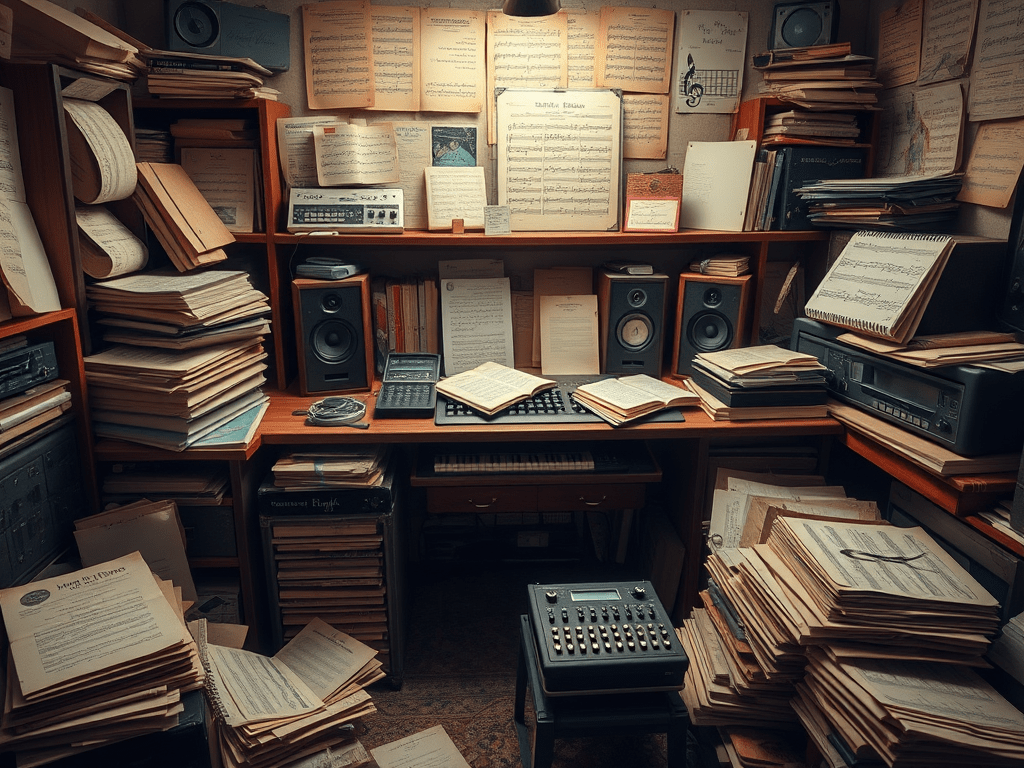
What do archives tell us about the person who has collected and organised (or disorganised) them over the years, about their own creative process, about their ‘workshop’?
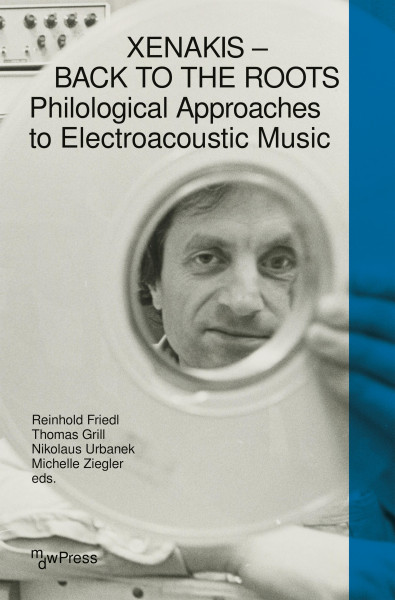
In this book (just published) “XENAKIS – BACK TO THE ROOTS. Philological Approaches to Electroacoustic Music” edited by Reinhold Friedl, Thomas Grĭll, Nikolaus Urbanek, and Michelle Ziegler, I present my article :
“Archives, Sources, Persons and Personae in the Art of Electronic Sounds”.
The volume “XENAKIS – BACK TO THE ROOTS. Philological Approaches to Electroacoustic Music” is devoted to philological case studies of the electroacoustic work of Xenakis, a composer who has so far still received too little attention from researchers (second section of the volume “Philological Practice”). But the special characteristics of Xenakis’s compositions make it possible to deepen basic philological research in the field of electroacoustic music (first section of the volume “Philological Context”).
It is in this first part of the book that my article “Archives, Sources, Persons and Personae in the Art of Electronic Sounds” appears. In it, I reflect on the concept of the electronic music archive as a uniform entity, a collection of individual heterogeneous sources, and finally a mirror of the very personality of the collector of those sources. I retrace the personal archives of Teresa Rampazzi, John Chowning, Camillo Togni, Fausto Romitelli, Maria Maddalena Novati (and what became NoMus), which become case studies for a more general discourse on the relationship between the organized or disorganized archiving of one’s own materials with the image that the persons want to convey of themselves and in intimate connection with one’s inner identity.
Extracts from my chapter are on googleooks: https://rb.gy/6i491x
Link to the book:
https://cup.columbia.edu/…/xenakis-back…/9783837674293
The volume contain articlesby James Harley, Elena Minetti, Pierre Carrè, François Delécluse, Marko Slavicek, Peter Nelson, Curtis Roads, Michel Chion.
 laura zattra
Leave a comment