
In my recent article COMBINED METHODS TO STUDY COLLABORATION, CO-CREATION AND COLLABORATIVE PERFORMANCE IN THE DIGITAL MUSIC ERA. THREE CASE STUDIES BETWEEN ORAL HISTORY AND SOURCE CRITICISM, I give a theoretical frame and contextualization of my research method, which I developed to study various aspects of music with new technologies (sound-based art).
The combination of source criticism, collaborative practices, oral history, fieldwork, and comparative analysis has characterized my research for 25 years, initially in an unconscious and intuitive way, then gradually acquiring a sense of necessity.
Here I have written about this method, but I have also applied it to three case studies: Fausto Romitelli’s Professor Bad Trip: Lesson I for eight players and electronics (1998); Mauro Lanza’s and Andrea Valle’s Regnum animale for amplified string trio and electro-mechanical devices (2013); and Clara Iannotta’s multimedia project Outer Space for baryton sax, percussion, electric guitar, one objects performer, amplified grand piano, midi-keyboard, live video and live electronics (2018).
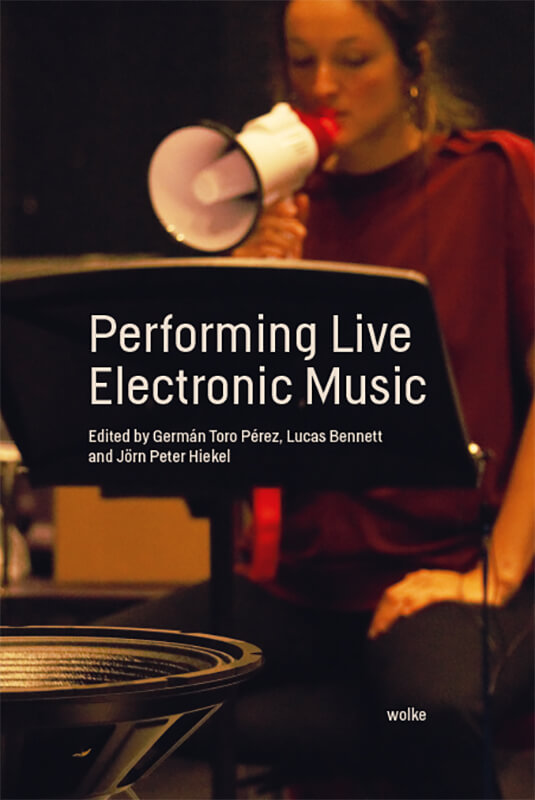
Laura Zattra (2024), “Combined methods to study collaboration, co-creation and collaborative performance in the Digital Music era. Three case studies between oral history and source criticism”, in Performing Live Electronic Music, edited by G.T. Perez, L. Bennett & J.P. Hiekel, Wolke Verlag, 2024, pp. 173-207.
The methodology considers, for each of the three pieces, four areas of study that correspond to my lines of research: reconstruction of the creative process before and after the composition of a work, study of collaboration, archiving (sources, documentation, self-documentation, and sensitivity to these preservation issues), and finally oral history. In contrast to my past research projects, in which I used sources in view of a single purpose (this could be analysing a musical work, reconstructing the creative process, reconstructing a biography or the history of an electronic music centre, studying the interaction between agents and operations within the creative process, reconstructing lost sources, discovering hidden figures who were indispensable to the creative process, e.g., computer music designers and sound designers), in this article I combine the above-mentioned four research paths in a coherent manner.
My chapter presents in the following order: an overview of the status of the academic research for each of the directions outlined (section 2), and the method of my present investigation (section 3). The outcomes of the three case studies (presented in sections 4-8) are obtained through a questionnaire submitted to the agents involved in the three different productions. The aim was to examine the creative process (single or collaborative) and to understand the collaboration process (section 4), to investigate how aware the actors are of the importance of documentation (section 5), and to examine their practices of notation, transmission, and preservation of the know-how including whatis not precisely written in the score, and to investigate the meta-cognition in this process – the awareness of their thought processes and the understanding of the patterns behind them (section 6). Finally, in a comparative perspective, the purpose was to analyse the workflow that took place in each of the three productions (section 7) and to present final remarks also on the level of authoriality and recognition (section VIII).
I deeply express my heartfelt thanks to German Toro Pérez, Lucas Bennett, and @Jorn Peter Hiekel for inviting me to participate in the final stages of your super project Performing Live Electronic Music developed at the Institute for Computer Music and Sound Technology (ICST) of the Zurich University of the Arts (ZHdK).

 laura zattra
Leave a comment